Amsterdam hotel prices are up 50% since 2019. Barcelona is up 35%. New York City hotels are at their strongest pricing power in a decade. In every case, the timing matches exactly one event: the city banned or severely restricted Airbnb. The people who pushed to remove short-term rentals from these cities wanted to protect housing. What they also did — unintentionally — was hand hotels a monopoly. And you are paying for it every time you book.
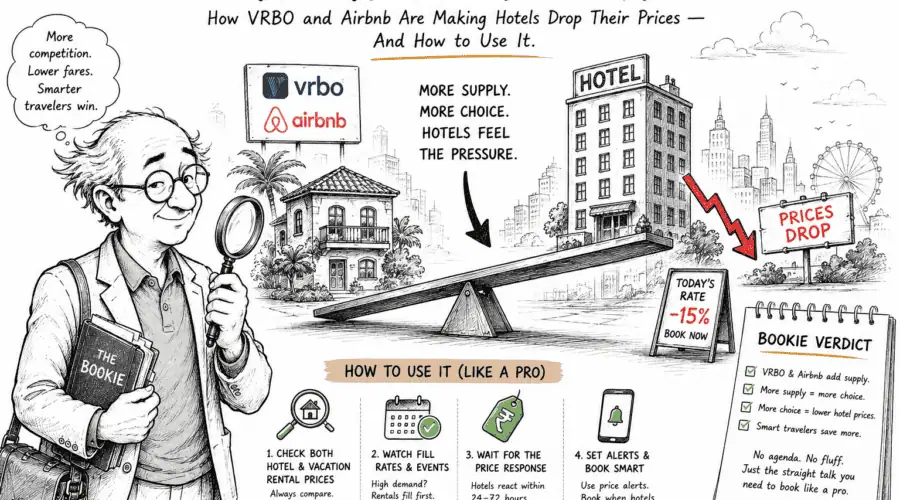
Cities that ban Airbnb see hotel prices surge. Cities with thriving short-term rental markets keep hotels competitively priced. This is not a coincidence — it is basic supply and demand. The Bookie’s strategy: know which cities have restricted Airbnb before you book a hotel there, because those are precisely the cities where hotel prices have moved furthest from fair value.
The mechanism nobody explains to travellers
For over a decade, Airbnb’s 8+ million listings globally acted as an invisible price ceiling on hotels. When hotels in a city priced too aggressively, travellers shifted to short-term rentals. Hotels knew this. They priced accordingly. Competition — even imperfect competition between very different product types — kept rates in check.
Then cities started banning or capping short-term rentals. The justification was housing — and the housing argument is genuinely complex and debated. But the accommodation market consequence is simple and documented: when Airbnb supply disappears, hotel pricing power returns immediately. Every displaced short-term rental guest becomes a hotel guest with no alternative. Hotels know this too — and they price for it.
The data from the cities that moved earliest and hardest against short-term rentals is now available. The Bookie has gone through it. The picture is unambiguous.
“Every city that banned Airbnb gave its hotels a monopoly. Travellers who do not know this are paying premium prices in markets where competition has been legislated away.”
— The Bookie
City by city — who banned Airbnb and what happened to hotel prices
Amsterdam — hotel prices up 50%
Amsterdam introduced strict short-term rental restrictions in 2018 and has tightened them repeatedly since. The cap on rental nights has been reduced and entire neighbourhoods have been effectively banned from hosting short-term guests. The result: hotel prices in Amsterdam rose 50% between 2019 and spring 2025 — a period that included two years of pandemic travel suppression. Post-pandemic recovery accounts for some of that increase. The Airbnb supply removal accounts for the rest.
Central Amsterdam now has 15 times more hotel rooms than Airbnb listings. The competitive balance that once kept Amsterdam hotel pricing in check no longer exists in any meaningful form. Hotels in the canal district know they have captured demand with nowhere else to go.
Barcelona — hotel prices up 35%, €64 million fine for Airbnb
Barcelona’s war on short-term rentals has been the most visible in Europe. In June 2025, protesters took to the streets with water pistols spraying tourists. In December 2025, the Spanish government imposed a €64 million fine on Airbnb for over 65,000 unlicensed listings. The city has been systematically reducing short-term rental licences for years.
Barcelona’s Old Town now has approximately seven hotel beds for every short-term rental bed. Hotel prices have risen 35% since 2019. Spain’s authorities have approved 800+ new hotel projects adding 75,000 new rooms by 2026 — but new supply takes years to hit the market. In the interim, the hotels that exist are pricing into reduced competition.
The Bookie’s Barcelona position: this is precisely why Lisbon — which has lighter short-term rental regulation and therefore stronger price competition in accommodation — represents better hotel value than Barcelona for equivalent city break experiences. We covered this in detail in our Lisbon vs Barcelona comparison.
New York City — 90% of Airbnb listings wiped out overnight
New York’s Local Law 18, implemented in September 2023, was the most dramatic short-term rental crackdown of any major city. Active Airbnb listings in New York City plummeted by over 90% almost immediately. The law requires hosts to register with the city, be present during any guest stay, and limits guests to two per apartment. In practice, it eliminated entire-home short-term rentals in one of the world’s most visited cities.
New York City hotels responded exactly as the Bookie would have predicted. Hotel occupancy in New York reached 87.9% in 2025 — among the highest in the world — and average nightly hotel rates climbed accordingly. The city’s hotel industry regained pricing power it had not held since before the sharing economy emerged. For travellers, New York hotel rates are now at their most expensive in years relative to comparable global cities.
Paris — the next battleground
Paris reduced its annual short-term rental cap from 120 days to 90 days in late 2024 and the city’s deputy mayor for housing has publicly stated the target of eliminating 20,000 illegal Airbnb apartments. Paris drew 50 million tourists in 2025 — the world’s most visited city by some measures — and has approximately 75,000 short-term tourist rentals in its metro area. As those listings face elimination, the 50-million tourist demand has to go somewhere. That somewhere is hotels.
Paris hotel prices are already elevated. France leads global average hotel prices at $339 per night. As short-term rental restrictions tighten through 2026, the Bookie anticipates further hotel price pressure in central Paris arrondissements.
| City | STR restriction | Hotel price change | Bookie verdict |
|---|---|---|---|
| Amsterdam | Severe — night caps, zone bans | +50% since 2019 | Avoid peak season without budget plan |
| Barcelona | Severe — licence freeze, €64M fine | +35% since 2019 | Choose Lisbon instead where possible |
| New York City | Extreme — 90% of listings gone | 87.9% occupancy — decade high | Book far ahead or expect premium rates |
| Paris | Tightening — 90-day cap, enforcement | $339 avg/night — highest in Europe | More pressure coming — book early |
| Lisbon | Light regulation — competitive STR market | Hotels still competitively priced | ✓ Bookie Pick — book it |
| Tokyo | Regulated but not banned — STR competition exists | Hotels still value-competitive | ✓ Strong value in Oct–Nov |
| Tbilisi | Minimal regulation — open market | Hotels still $75–$110/night 5-star | ✓ Bookie’s top pick 2026 |
The reverse also holds — where Airbnb oversupply is suppressing hotel prices
The mechanism runs in both directions. In markets where short-term rental supply has grown faster than demand, short-term rental occupancy is falling — and hotels are being forced to compete harder on price to attract guests who now have more alternatives than ever.
US beach and leisure destinations are the clearest example. The national US Airbnb occupancy rate has fallen from 57% in 2024 to approximately 50% in 2025 as supply growth outpaced demand. Ocean City, Maryland sits below 35% occupancy. Miami Beach, Scottsdale, and other sun-belt leisure markets are seeing Airbnb hosts cut rates aggressively — and hotels in those same markets are following them down.
Emerging European cities with lighter regulation are showing the same pattern. Belgrade, Tirana, Tbilisi — markets where short-term rentals operate openly and in volume — also happen to be the markets where hotel prices remain at their most competitive. The connection is direct.
Florence has banned all new STR licences in its historic centre. Edinburgh introduced a tourist tax in 2024 and enforcement against unlicensed rentals escalated in 2025. Prague’s city centre is tightening. Each of these cities will see hotel pricing move upward as STR supply shrinks. Book hotel stays in these cities sooner rather than later — or plan alternative destinations.
The Bookie’s framework: how to read a city’s accommodation market before booking
Before booking any hotel in an unfamiliar city, the Bookie runs a three-question check that takes under two minutes:
- Does this city have significant short-term rental restrictions? Search “[city] Airbnb ban” or “[city] short-term rental regulation.” If the city has capped, licensed, or banned short-term rentals aggressively, hotel pricing power is elevated — budget accordingly or choose an alternative destination.
- What is the current Airbnb supply like? Open Airbnb.com and search the city for your dates. If you see hundreds of results across the city, competition is alive and hotels are being kept honest. If results are sparse or concentrated only outside the centre, hotels have reduced competition — and know it.
- Is the destination replaceable? If the city has restricted Airbnb and hotel prices are elevated, is there an equivalent destination with lighter regulation and lower hotel prices? Lisbon for Barcelona. Belgrade for Vienna. Tbilisi for Prague. The Bookie recommends the switch whenever the experience is genuinely comparable.
Where Airbnb itself is fighting back — and what it means for travellers
Airbnb is not sitting still. CEO Brian Chesky stated in Q2 2025 that the company is “going significantly more aggressively into hotels” — specifically boutique hotels, bed and breakfasts, and inns in cities where traditional short-term rental supply has been regulated away. Airbnb is effectively trying to restore accommodation competition in regulated markets by bringing licensed hotel supply onto its platform.
This is actually good news for travellers — and for the Bookie’s core argument. If Airbnb succeeds in bringing boutique hotel inventory into its platform in New York, Barcelona, and Paris, it will partially restore the competitive pressure on established hotels that regulation removed. Prices may stabilise. The markets that have moved farthest from fair value have the most to gain from restored competition.
For 2026 and beyond, the Bookie is watching this development closely. A city where Airbnb has been banned but boutique hotels are now listed on Airbnb is a city where competitive dynamics are shifting again — potentially in the traveller’s favour.
The practical upshot — the Bookie’s city-by-city booking strategy
Given everything above, here is how the Bookie approaches hotel booking in 2026’s regulatory landscape:
- Amsterdam — book far ahead, compare Booking.com and direct rates
- Barcelona — consider Lisbon instead; if Barcelona is necessary, book 6–8 weeks ahead
- New York City — book 4–6 weeks minimum ahead; last-minute rates are punishing
- Paris — book early; avoid July–August peak when demand is maximum and STR supply is most restricted
- Florence — historic centre hotels now operate with almost zero STR competition
- Lisbon — open STR market keeps hotel prices honest; 50% cheaper than Barcelona
- Tbilisi — minimal regulation, maximum hotel value; 5-star from $75-$110
- Tokyo — regulated but competitive; Agoda for best rates in Oct–Nov window
- Belgrade — emerging city with open market; comparable to Vienna at 40% of the price
- Dubai — permissive STR rules coexist with aggressive hotel expansion; summer pricing window exceptional
For competitive-market hotel destinations — Lisbon, Tbilisi, Tokyo, Belgrade — Booking.com has the strongest inventory at fair prices:
Search Booking.com → Compare on Agoda →The Airbnb regulation debate is genuinely complex — the housing arguments are real and the communities affected are real. But the accommodation pricing consequence is simple and documented: cities that remove short-term rental competition hand their hotels a monopoly, and hotel prices move accordingly. The traveller who understands this is the traveller who books Amsterdam in March instead of August, chooses Lisbon over Barcelona, and finds Tbilisi before the rest of the world catches up. That is the entire game. Know which markets have competition. Book those markets. Avoid the monopoly premium wherever an alternative exists.