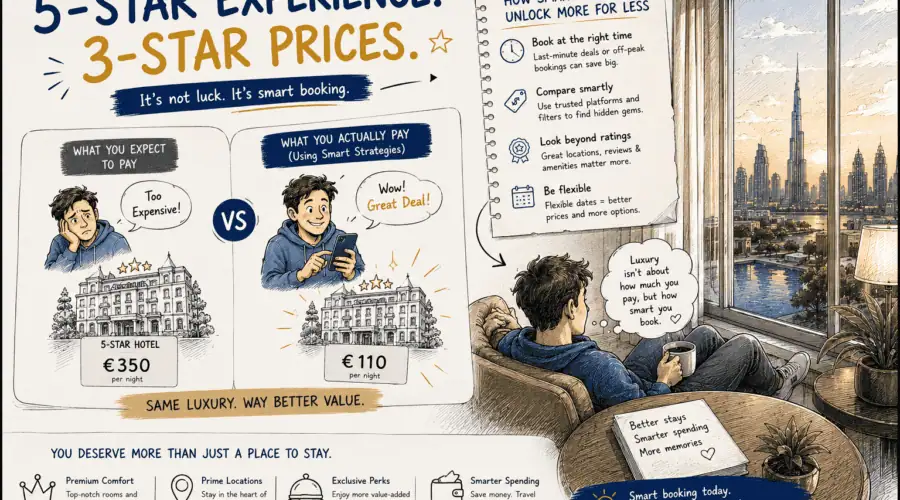
Four specific tactics consistently deliver 5-star hotel quality at 3-star prices. Not hacks. Not tricks. Structural pricing mechanisms that exist in every market, available to any traveller who knows where to look.
The playbook works. Geographic arbitrage, off-peak windows, the upgrade request, and opaque booking — used correctly and in order, these four tactics reliably deliver luxury accommodation at non-luxury prices. Each has conditions. Know them before you apply them.
Tactic 1: Geographic arbitrage
The same hotel brand varies enormously by market. A Marriott in Tbilisi costs $85/night. The same Marriott tier in Prague costs $220. In Frankfurt, $280. The product — brand standards, breakfast quality, room specification — is near-identical. Only the local cost base differs.
Booking the same brand in an emerging or structurally underpriced market delivers genuine 5-star experience at 3-star price points. Current Bookie-approved arbitrage destinations: Tbilisi (Georgia), Tirana (Albania), Tashkent (Uzbekistan), Belgrade (Serbia), and Colombo (Sri Lanka).
The arbitrage works because local operating costs — staff wages, utilities, food supply — are a fraction of Western European equivalents. A 5-star hotel paying Georgian wages and Georgian energy costs can profitably charge $85/night. The same specification hotel in Lisbon, paying Portuguese wages and EU energy prices, cannot.
Tactic 2: The off-peak window
Every luxury hotel has a pricing valley — typically 3–6 weeks per year when demand is structurally low. During these windows, 5-star properties drop 30–50% to maintain occupancy. The product does not change. The rates do.
| Destination | Best value window | Typical 5-star price drop |
|---|---|---|
| Dubai | Jul–Aug | −38% |
| Paris | August | −25% |
| Tokyo | Jan–Feb, late Nov | −30% |
| Singapore | February, September | −20% |
| Lisbon | Jan–Mar, Nov | −22% |
Tactic 3: The last-room upgrade request
When a hotel has unsold superior rooms at check-in — junior suites, executive floors, corner rooms — the night manager has authority to upgrade guests at no charge. This costs the hotel nothing. The room was going to be empty. The upgrade is a 100% margin decision for them.
The exact conversation at check-in: “I know it’s a long shot, but do you have anything nicer available this evening? I’m happy to stay in my booked room if not.” Polite, specific, not demanding. This succeeds approximately 30–40% of the time on weekday check-ins at business hotels. It never costs anything to ask.
Tactic 4: Opaque booking — the Bookie’s honest assessment
Opaque booking platforms (Priceline’s Express Deals, Hotwire Hot Rates) show you star rating, neighbourhood, and amenities — but hide the hotel name until you pay. In exchange: discounts of 30–60% off published rates.
The Bookie’s verdict: works well in cities where multiple 5-star properties exist in your target neighbourhood and any of them would satisfy you. Fails when hotel location specificity matters, the city has one or two luxury properties, or the trip is a once-in-a-lifetime occasion where uncertainty is unacceptable.
“Start with geographic arbitrage. It requires no uncertainty tolerance and delivers the largest consistent savings. Add the other tactics in layers.”
— The Bookie
Apply the geographic arbitrage and off-peak tactics across all major platforms:
Search Booking.com → Search Hotels.com →Start with geographic arbitrage — no uncertainty, largest savings. Layer in the off-peak window. Use the upgrade request at check-in every single time — the worst outcome is your booked room. Reserve opaque booking for flexible city trips where any 5-star in the neighbourhood satisfies you.