🎯 Bookie Pick · 🕐 9 min read · 📅 Originally December 2010, updated May 2026 · 👤 Dan Winther
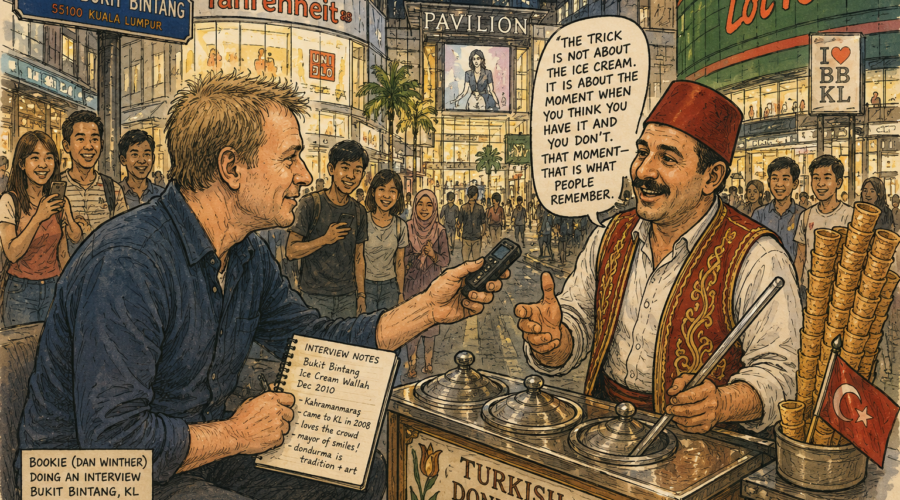
I was walking down Jalan Bukit Bintang on a sweltering December evening when I heard the bell. A crowd had gathered on the pavement outside Fahrenheit 88 — twenty, maybe thirty people, laughing and craning their necks at something I couldn’t yet see. Then I got close enough to understand. There was a man in a red Ottoman vest and a fez, holding a long metal paddle, and he was making a complete fool of everyone who tried to get their ice cream cone.
I stayed for an hour. Then I asked if I could interview him. He said yes — in the way that a man says yes when he knows the story he is carrying is worth telling.
📍 The Turkish dondurma sellers of Bukit Bintang have traditionally worked the stretch between Fahrenheit 88 and Lot 10 on Jalan Bukit Bintang — on foot, from push carts, or from small kiosks. The vendor in the video below worked this strip from the late 2000s.
The Man Behind the Tricks
His name was not what most passersby were thinking about. They were thinking about the cone. He had just handed it to a teenage girl, then somehow had it back in his hand before she registered what happened. The crowd erupted. She laughed too, eventually.
When the crowd thinned and he had a moment, I asked him where he was from. Kahramanmaraş — the city in southeastern Turkey that is ground zero for dondurma, the ice cream so unlike anything else in the frozen dessert world that calling it simply “ice cream” feels inadequate.
“The trick is not about the ice cream. It is about the moment when you think you have it and you don’t. That moment — that is what people remember.”
— The ice cream wallah of Bukit Bintang, interviewed by Dan Winther, December 2010
What Is Dondurma — And Why Does It Stretch?
Most people watching the performance on Jalan Bukit Bintang assume the tricks are theatre for tourists. They are — but they work because of the ice cream itself. Dondurma (the Turkish word literally means “freezing”) is made with two ingredients you will not find in any ordinary soft serve: salep and mastic.
Salep is a flour ground from the tubers of wild orchids native to the Anatolian highlands — particularly the Kahramanmaraş region. Mastic is a resin from the mastic tree that adds a subtle pine-like aroma and a second layer of elasticity. Together they create something that behaves more like warm dough than frozen dessert — dense enough to slice with a knife, stretchy enough to flip upside down in a cone without falling, and resistant to melting even on a 34°C Kuala Lumpur afternoon.
Dondurma vs Regular Ice Cream
| Property | Regular ice cream | Turkish dondurma |
|---|---|---|
| Texture | Smooth, creamy | Chewy, stretchy, dense |
| Melting speed | Fast — especially in KL heat | Slow — holds shape for minutes |
| Key ingredient | Stabilisers, emulsifiers | Salep (orchid root) + mastic resin |
| Can you eat it with a fork? | Not really | In Maraş — sometimes, yes |
| Will the seller tease you? | No | Absolutely. Every single time. |
The origin story most often told about dondurma traces back to an Ottoman merchant named Osman who buried an unsold batch of hot sahlep drink in snow overnight. He retrieved it the next morning as something entirely different. Whether or not the story is true, the city of Kahramanmaraş has been making dondurma for centuries and considers it a matter of civic pride.
The Show Is the Point
What makes the Bukit Bintang encounter memorable is not just the ice cream — it is the performance. Great travel experiences are rarely about the object in your hand. They are about the unexpected moment of human connection in the middle of an ordinary street.
The vendor’s toolkit is deceptively simple: a long-handled metal paddle to knead and stretch the dondurma in a brass cylinder, a cone, and a mastery of sleight of hand built over years. The tricks themselves have a logic. Because dondurma is sticky and elastic, you genuinely cannot predict what will happen to it. The vendor exploits that unpredictability — spinning it, flipping it, handing the cone to you only to have it empty, making it appear to defy gravity. He is not deceiving you. He is showing you what the ice cream can actually do.
[Add your personal observation here — what specific trick did he perform? What was the crowd reaction? Did he speak to the audience while performing?]
From Kahramanmaraş to KL — A Long Way to Travel with Ice Cream
Turkish dondurma sellers first appeared in Kuala Lumpur in the early 2000s, drawn by the city’s dense tourist footfall around Bukit Bintang, its tolerance for street vendors, and a Malaysian appetite for novel food experiences. The Fahrenheit 88 to Lot 10 corridor — running along Jalan Bukit Bintang — became the strip where several vendors set up, competing as much through performance as through the quality of the ice cream itself.
Brands like Booza and Mado Café opened physical outlets on the strip in the 2010s. Most have since closed. A Malaysian-made dondurma brand called Krem Tarik — the name is Malay for “pulled cream” — has since picked up the torch, bringing the stretchy tradition to a new generation of Malaysian customers.
The salep supply is another story. Turkey has restricted the export of salep to protect dwindling wild orchid stocks. Vendors abroad today often substitute guar gum or konjac for a similar elastic effect. The real thing — ground from Anatolian orchid tubers — is increasingly rare outside Turkey itself.
Why This Story Matters for Travellers to Kuala Lumpur
Bukit Bintang is well covered as a travel destination. Every guide covers KL’s shopping malls, the Petronas Towers, the food courts. Very few stop to notice the man with the paddle and the fez who has been standing on the same patch of pavement every evening, performing the same ancient trick for a fresh crowd every twenty minutes.
There is a version of travel that is about ticking off landmarks. Then there is a version where you slow down enough to ask a man in a red Ottoman vest what he thinks about Malaysian crowds versus Turkish ones. That second version is usually the one you remember fifteen years later.
The ice cream, for what it is worth, is excellent. Dense, subtly aromatic from the mastic, surprisingly satisfying in the heat. Worth every ringgit — and the five minutes of dignity it costs you to try to get the cone out of his hand.
Bukit Bintang has no shortage of things to eat and buy and look at. The Turkish ice cream wallah is not a restaurant or a mall or a landmark. He is a one-man theatre troupe who also happens to sell the most technically unusual frozen dessert in the world. If you are staying anywhere near Jalan Bukit Bintang — walk the Fahrenheit 88 to Lot 10 stretch on an evening. Listen for the bell.
Staying in Bukit Bintang? The Bookie’s preferred hotels on this strip:
Find hotels near Jalan Bukit Bintang on Booking.com →
Frequently Asked Questions: Turkish Ice Cream in Bukit Bintang
What is the Turkish ice cream sold in Bukit Bintang called?
It is called dondurma — the Turkish word for “freezing.” Unlike regular ice cream, dondurma is made with salep (orchid root flour) and mastic resin, giving it a dense, stretchy, chewy texture that allows vendors to perform their famous tricks. The style sold in Bukit Bintang is typically Maraş dondurması, originating from the Kahramanmaraş region of southeastern Turkey.
Where exactly in Bukit Bintang can you find Turkish ice cream?
The traditional stretch for Turkish ice cream sellers in Bukit Bintang is along Jalan Bukit Bintang between Fahrenheit 88 and Lot 10. Vendors have historically worked this strip on push carts and at small kiosks, particularly in the evenings. Availability varies — street vendors are most reliable on weekends and peak tourist evenings.
Why does the Turkish ice cream seller keep pulling the cone away?
This is the famous dondurma trick — a performance tradition that grew out of the ice cream’s unusual elastic properties. Because dondurma is sticky and stretchy, it can be flipped, spun and manipulated in ways regular ice cream cannot. Vendors in Ottoman-style costume have developed elaborate sleight-of-hand routines around this, turning each sale into a short comedy performance.
What makes Turkish dondurma different from regular ice cream?
Two ingredients set dondurma apart: salep (flour ground from wild orchid tubers found in the Anatolian highlands) and mastic (a tree resin). Together they make the ice cream dense, elastic and slow to melt — properties that allow it to be sliced with a knife, stretched like taffy, and eaten upside down in a cone. It is beaten and kneaded during preparation rather than simply churned, which further develops its unique texture.
Is the Turkish ice cream in Bukit Bintang authentic?
The ice cream sold by street vendors in Bukit Bintang uses the basic dondurma formula — salep, mastic, milk and sugar — though some vendors abroad substitute guar gum or konjac for salep since Turkey has restricted salep export to protect dwindling wild orchid stocks. The performance and technique are authentic. The ingredient sourcing varies by vendor.
Sources: Wikipedia — Dondurma · Türkiye Today — History of dondurma · Malaysian Foodie — Booza Turkish Ice Cream · Vulcan Post — Krem Tarik