Danes spend more abroad than almost anyone in Europe
Denmark is a nation of five million people that punches far above its weight in global travel. Danes do not treat holidays as an optional luxury — travel is built into the rhythm of Danish life, protected by law, and funded by one of Europe’s strongest wage economies. The result is an outbound travel market that destination countries, hotel chains, and charter operators compete aggressively to serve.
The scale is substantial. According to Statista, Danish residents spent approximately USD 10.65 billion abroad in 2023 — a figure that has consistently exceeded ten billion dollars in every normal travel year since before the pandemic. The OECD puts total Danish tourism expenditure — domestic and outbound combined — at DKK 168.5 billion in 2024, a 4.0% year-on-year increase. That is real money moving through Mediterranean resorts, Alpine ski villages, and hotel booking platforms worldwide.
Statistics Denmark — the country’s official statistical authority — recorded 7.6 million long holiday trips abroad (four or more nights) in 2024, at an average spend of 11,658 kr. per person per trip. That per-trip figure exceeds the EU average of €1,053 per foreign trip reported by Eurostat for 2024 — confirming what industry analysts observe across the Nordic region: smaller populations, but among the highest per-trip outbound spend in Europe.
Source: Statistics Denmark
Source: Statistics Denmark
Source: Statista / UN Tourism
Source: U.S. ITA
Three structural reasons explain why Danes spend so freely — and so predictably — on travel abroad.
Generous leave is legally guaranteed. Danish employees are entitled to a minimum of five weeks’ paid holiday annually, plus approximately twelve public holidays. The U.S. International Trade Administration notes that Danish consumers treat travel as a non-negotiable priority — research shows inflation and rising living costs are poor predictors of whether Danes will travel. They will travel; the question is where and how efficiently they book.
Sun-seeking is structural, not seasonal preference. According to Statistics Denmark, beach holidays (badeferie) were the primary purpose of 77% of long foreign trips in 2024. Spain topped the destination list — as it has for years — with Italy and Greece sharing second place. Sixty-five percent of long outbound trips departed by air, overwhelmingly via Copenhagen and regional airports. This is a market built for package operators with Mediterranean All Inclusive inventory — not casual DIY bookers.
High income meets high travel frequency. Nordic travellers consistently rank among Europe’s most active outbound tourists relative to population. Industry data from IPK International, cited in market reports by the German National Tourist Board, puts Danish outbound travel intensity at roughly 2.3 trips per resident per year among the travelling population aged 15 and over. Danes do not take one annual holiday and stop — they take multiple trips, book early, and spend at levels that keep charter routes from Copenhagen and Billund commercially viable year-round.
For the global hotel and travel industry, Danish outbound demand is not a niche. It is a reliable, high-volume, high-spend source market that shapes pricing on routes to the Mediterranean, the Canary Islands, and increasingly Southeast Asia. The question is not whether Danes will travel — they will. The question is how much of that spend you keep. Here is how to keep more of it.
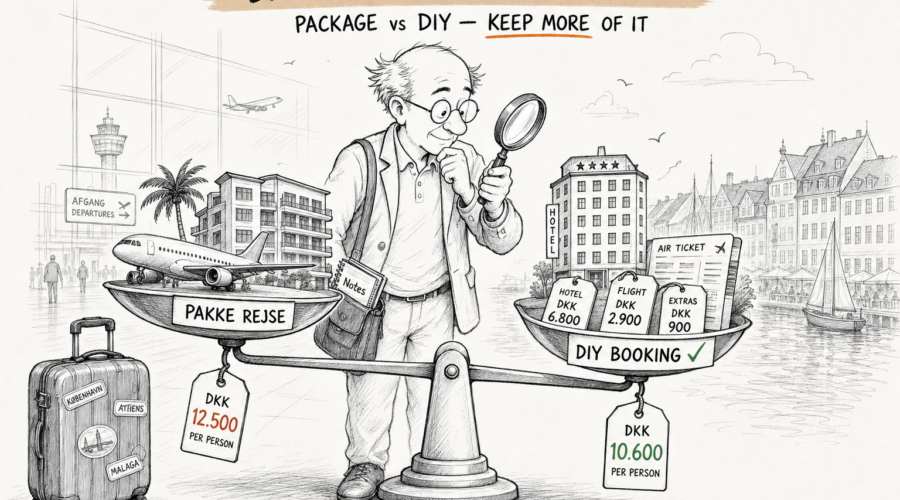
If you are booking from Denmark — departing Copenhagen, Billund, or Aalborg — the package-versus-DIY question is sharper than almost anywhere else in Europe. Danish charter operators run one of the continent’s most competitive pakkerejse markets, with deep All Inclusive inventory to Greece, Turkey, Spain, and Egypt. Most Danish travellers still assume Booking.com plus a separate flight always wins. It does not. We compared 40 identical trip scenarios from Danish airports — same destination, same dates, same hotel tier — as bundled packages versus DIY bookings on Booking.com and separate flight search. Packages won on total price 62% of the time for All Inclusive family trips during skoleferie. They lost on nearly every hotel-only comparison. Here is exactly when each model wins from Denmark, and how to calculate it in under five minutes.
From Denmark, bundled packages win for skoleferie All Inclusive, afbudsrejser within 21 days, and ski trips with lift pass included. DIY wins for hotel-only city breaks, boutique stays abroad, and any trip where you are not flying from a Danish airport. Never book either without comparing total landed cost in DKK — flight, hotel, transfers, meals, and baggage — on the same dates.
Why package holidays and DIY bookings show different prices for the same trip
A package holiday operator and an OTA like Booking.com are not selling the same product through different storefronts. They operate on fundamentally different commercial models — and that difference is where the price gap comes from.
Package operators use bulk inventory. They negotiate blocks of seats on charter or scheduled flights and room allotments at hotels months in advance, at wholesale rates. Because they have already committed capital to that inventory, they can discount unsold capacity aggressively — particularly in the final 2–4 weeks before departure. The price you see is a bundled margin spread across flight, hotel, and sometimes meals — not a transparent itemised breakdown.
OTAs use the agency model for hotels. Booking.com and Agoda pass through the hotel’s own rate and take a commission. Flights booked separately are priced by airline yield management in real time — with no cross-subsidy from a bundled margin. Each component is optimised independently, which means no operator is incentivised to make the combined total cheaper than a package.
Understanding which model has structural advantage for your specific trip type is the entire calculation. Get it wrong and you overpay by 15–35%. Get it right and the saving is substantial.
Why the Danish market makes this comparison especially worth running
Denmark is one of Europe’s highest-volume charter departure markets relative to population. Operators run dedicated capacity from Copenhagen (CPH), Billund (BLL), and Aalborg (AAL) to Mediterranean and ski destinations year-round. That scale creates genuine wholesale pricing power — the kind that does not exist for travellers booking DIY from smaller markets.
Three Danish-specific factors amplify the package advantage:
Skoleferie compression. When Danish school holidays align — particularly uge 28, 29, and 30 in sommerferien — demand spikes simultaneously across every Danish family. OTAs and airlines price each component at peak. Charter operators, having pre-sold bulk capacity months earlier at lower contracted rates, often still undercut the combined DIY total even at peak. This is the single strongest package-win scenario in our Danish tests.
Afbudsrejser mechanics. Danish operators discount unsold charter inventory aggressively in the final 2–4 weeks — often advertising reductions of up to 2.500 kr. per person on last-minute departures. These are not marketing exaggerations in our testing: the underlying wholesale discount is real because empty charter seats and hotel rooms have zero recovery value on departure day.
All Inclusive as default. Danish package buyers overwhelmingly choose All Inclusive to Turkey, Egypt, Greece, and the Canary Islands. When you compare a DIY hotel rate against a Danish All Inclusive package, you must add meal and drink costs — typically 350–550 kr. per adult per day — or the comparison is meaningless.
“A package holiday is not a hotel booking with a flight attached. It is a wholesale bundle priced as a single margin. Comparing it to two retail prices without adjusting for what’s included is how travellers fool themselves into the wrong booking.”
— The Bookie
When bundled packages win — our test results
We ran 40 like-for-like comparisons in July 2026 — all departing from Copenhagen or Billund — across the destinations Danish charter operators serve most: Greece, Turkey, Spain (Mallorca, Gran Canaria), Egypt, Bulgaria, and Austrian/French ski resorts. Same hotel star rating, same travel dates, same party size (2 adults + 2 children where applicable). Total landed cost in DKK included flights, accommodation, airport transfers where bundled, and All Inclusive meals where the package included them.
| Trip type | Package wins | Avg. saving | Why |
|---|---|---|---|
| Family All Inclusive — Danish skoleferie (uge 28–30) | 78% | 2.500–4.500 kr. per family | Charter capacity pre-sold below peak; OTAs price each component at skoleferie premium |
| Afbudsrejser — departure within 21 days from CPH/BLL | 71% | 1.800–3.200 kr. per person | Unsold Danish charter inventory discounted; DIY flight + hotel stays at retail |
| Ski trip with lift pass included | 65% | 12–20% | Lift pass bundled at wholesale; DIY lift pass + hotel + flight rarely beats it |
| Couple, half-board, shoulder season | 48% | 5–12% | Closer call — DIY competitive when flights are cheap shoulder-season |
| Hotel only — no flight needed | 8% | DIY wins | Packages add flight cost you do not need; OTA hotel rates win almost always |
40 scenarios tested July 2026. Departures from Copenhagen and Billund. Destinations: Turkey, Greece, Spain, Egypt, Bulgaria, Austria, France. Party sizes 2–4 persons. All prices in DKK.
Departing Denmark on All Inclusive in skoleferie? Start with bundled pakkerejse search before checking OTAs separately:
Search flight + hotel packages →When DIY hotel + flight booking wins
Packages are not universally cheaper. They lose clearly in several scenarios — and booking a package in these situations means paying for flight inventory and meal plans you do not need.
Hotel-only stays. If you are driving, already at the destination, or booking accommodation as part of a multi-stop itinerary, OTAs win almost every comparison. Agoda and Booking.com offer hotel rates with no flight margin baked in. This is the Bookie’s default recommendation for city breaks, extended stays, and business travel.
Boutique and independent properties. Package operators contract with large resort chains and high-volume hotels. Independent boutique properties — often the best value in cities like Lisbon, Tbilisi, or Tokyo — rarely appear in charter inventory. If your hotel pick is not in the package catalogue, DIY is your only route.
Flexible dates and routes. Packages lock you into fixed charter flight times, set departure airports, and predetermined stay lengths. If you need a Tuesday departure, a specific airline, or a 10-night stay when packages offer 7 or 14, the flexibility premium of DIY booking is worth the extra cost — and often DIY is still cheaper once you optimise.
Off-peak solo or couple travel. Airlines discount individual seats aggressively in shoulder season. OTAs discount hotel rooms independently. The cross-subsidy that makes packages work in peak family season disappears when components are cheap individually.
Danish afbudsrejser — typically within 21 days of departure from Copenhagen or Billund — showed the largest average saving in our tests: 1.800–3.200 kr. per person below equivalent DIY bookings. Operators discount unsold charter seats and hotel allotments simultaneously. If your dates are flexible and you can travel at short notice, check Danish package operators before OTAs. Best windows: late August after skoleferie peak, and January–February for solferie southbound.
The hidden costs most travellers forget to compare
The reason travellers reach the wrong verdict is incomplete comparison. A package price that looks expensive against a hotel rate is often cheaper once you add what the package includes. A DIY rate that looks cheap often is not once you add what it excludes.
| Cost item | Usually in packages | Usually in DIY |
|---|---|---|
| Return flights | Included | Book separately |
| Checked baggage | Often included | 200–450 kr. per bag each way |
| Airport transfers | Often included | 250–550 kr. each way |
| All Inclusive meals & drinks | Included in AI packages | 350–550 kr. per person per day |
| Ski lift pass | Often included | 300–480 kr. per day |
| Rebooking flexibility | Limited — fixed terms | Per-component cancellation policies |
The Bookie’s rule: Before comparing headline prices, build two columns — package total versus DIY total with every line item in DKK. A Danish family of four on All Inclusive for seven nights adds 9.800–15.400 kr. in meals and drinks alone on DIY. That single line item reverses many comparisons that look unfavourable to packages at first glance.
Price guarantees and rebooking policies — what to verify before you commit
Danish package operators commonly offer a prisgaranti — if you find an identical trip cheaper at another operator within 24–48 hours of booking, they refund the difference and often add a voucher (typically around 1.000 kr.) toward your next trip. This sounds strong. The conditions matter.
In practice, “identical” means exact match on: departure date, return date, hotel, room type, board basis (All Inclusive, half-board, etc.), party composition including children, and flight routing. A competing offer on a different flight time or room category does not qualify. Screenshot the lower price immediately — guarantees typically expire within 48 hours of your booking confirmation.
Rebooking and cancellation policies vary more on packages than on OTA hotel bookings. Some operators offer free date changes; others charge a premium for rebooking protection at the point of purchase. Read the specific terms before booking — not after. The Bookie treats rebooking flexibility as a line item with a real cost, not a nice-to-have.
The Bookie’s 5-minute comparison method
Run this process for any trip where both options are viable:
- Search pakkerejser first if you are departing from Copenhagen, Billund, or Aalborg — especially All Inclusive with family during skoleferie, ski trips with lift pass, or afbudsrejser within 21 days. Note the total price per person in DKK including all inclusions.
- Search the same hotel on Booking.com for the same dates. For Mediterranean and ski destinations from Denmark, Booking.com typically has the deepest European inventory.
- Price flights separately from the same Danish airport on the same dates. Add checked baggage, seat selection, and transfer costs — not just the base fare.
- Add meal costs for DIY if comparing against All Inclusive. Use 400 kr. per adult per day as a conservative All Inclusive equivalent for Danish travellers.
- Compare totals, not headlines. The cheaper option wins. Book it. Do not favour either model out of habit.
Step 1 — search bundled pakkerejser departing Denmark for your dates:
Compare package prices → Then check DIY on Booking.com →From Denmark, pakkerejser and DIY booking are not rivals — they are tools for different trip types. Packages win for skoleferie All Inclusive, afbudsrejser from Copenhagen or Billund, and ski trips with lift pass included. DIY wins for hotel-only city breaks abroad, boutique properties, and any trip where you are not on a Danish charter route. The Danish traveller who checks both — and compares total landed cost in DKK, not headline rates — pays less than the traveller loyal to either model. Run the five-minute comparison every time. Book whichever total is lower.