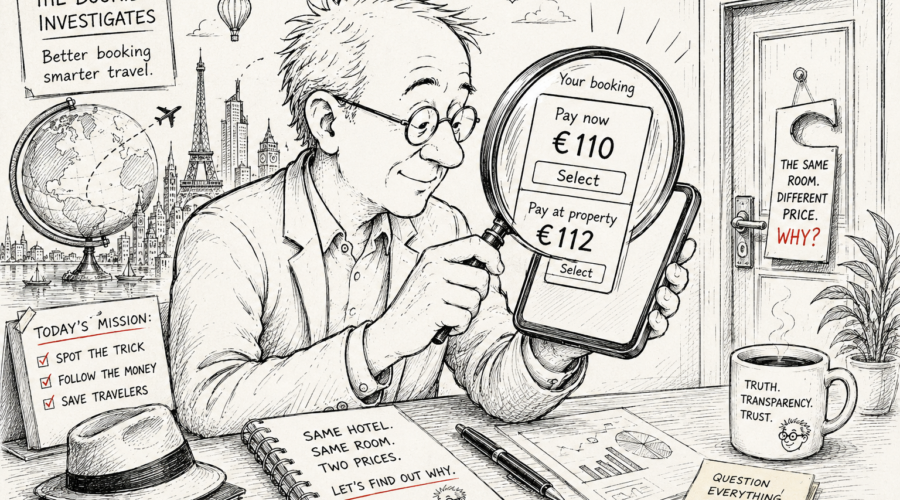
There’s a moment at the end of every hotel booking the platforms would rather you didn’t examine: two buttons, Pay now or Pay at the property, usually at two slightly different prices, with no explanation. Most travellers treat the pay now vs pay at hotel choice as a convenience question. It isn’t. It’s a cost question — and almost nobody does the arithmetic. So the Bookie did.
Pay at the property, in the local currency, on a no-foreign-fee card — unless your plans are 100% firm and the prepaid discount is real. The prepaid “saving” is usually you taking on cancellation risk for someone else’s benefit. And whatever you choose, the costliest mistake is letting a hotel or card machine convert to your home currency. Decline it every time.
First, the two choices — in plain English
Two different things get tangled together here, and the confusion is exactly where money leaks out. Pay now (prepaid) charges you the full amount today; the room is locked in and your money is gone now. Pay at the property (pay later) reserves the room with a card on file, then charges you at check-in or check-out in the hotel’s local currency.
Here’s the part people miss: prepaid and non-refundable are not the same axis. You can have a refundable pay-now rate, and a non-refundable pay-later rate. The platforms blur the two on purpose, because “Pay now and save 15%” sounds like a discount for convenience when it’s often a discount for giving up your right to cancel. Keep those two ideas in separate boxes and half the fog clears.
The 4 hidden costs nobody totals
- The prepaid currency bet. Prepaying a foreign stay in your own currency isn’t just paying early — it’s betting on an exchange rate the platform sets. The “today” price converts at the platform’s rate, rarely the mid-market rate your bank would use, and a spread is often baked in before you place the bet. Pay later in local currency and the conversion happens at check-out through your own card instead.
- The front-desk trap — this is the expensive one. Dynamic currency conversion (DCC) is when the front desk or card machine offers to charge you in your home currency “for convenience.” It is the single most reliable way to overpay — even Visa’s own guidance notes the home-currency option adds the exchange rate plus extra fees. A documented case saw a hotel apply a rate marked up roughly 15% over the official one — turning quotes of about $132 and $407 into $153 and $471, an $85 surprise for nothing. Always pay in the local currency. The “convenience” is the markup.
- The refundability you quietly traded away. That “Pay now and save” rate is very often the non-refundable rate in a discount’s clothing. The cost is optionality: one wobble — a cancelled flight, an illness — and a prepaid non-refundable room is a total loss. We audited where “free” cancellation actually holds and where it doesn’t in our Booking.com free cancellation test. Treat the discount as an insurance premium in reverse: on a firm trip, take it; on anything uncertain, that 10–15% is the cheapest travel insurance you’ll ever decline.
- Holds, deposits, and pay-at-property surprises. “Pay at property” doesn’t mean commit to nothing. Many hotels place a pre-authorisation hold on your card at or before check-in — sometimes the full stay — freezing funds even though nothing is taken. A valid card is usually required to guarantee the room, and a no-show can still trigger a one-night charge.
The Bookie’s math
One clean example — a €100/night room, two nights, booked from India for a trip abroad. Prepaid, non-refundable: the platform shows ₹18,100 today at their rate (~10% “discount”); if plans change, you lose all of it. Pay at property, refundable, local currency: you pay €200 at check-out on a no-FX-fee card at the real rate (~₹18,600), and nothing if you cancel in time. Pay at property but you accept DCC at the desk: that same €200 becomes ~₹21,400 at the marked-up rate.
The discount for prepaying was ₹500. The penalty for one wrong tap at the front desk was ₹2,800. The biggest number in this whole decision isn’t pay-now-vs-pay-later at all — it’s whether you say no to dynamic currency conversion.
“The discount for paying now is small. The penalty for one wrong tap at the front desk is not. Always pay in the local currency.”
— The Bookie
Frequently asked questions
Is it cheaper to pay now or at the hotel? Neither is automatically cheaper. Prepaid rates often carry a small discount in exchange for refundability; pay-later rates protect your flexibility. The bigger cost than either is the currency conversion — pay in local currency and the gap usually shrinks to a rounding error.
Will the exchange rate change if I pay at the hotel later? Yes. Pay at check-out and the conversion happens then, at your card’s rate. Prepaying locks in the platform’s rate today instead — which may or may not be better. You’re betting on currency movement either way.
Should I be charged in my own currency or the local one at the hotel? Always the local currency. Being charged in your home currency triggers dynamic currency conversion, which routinely adds a markup of 10% or more over the real exchange rate.
Is the non-refundable “pay now” rate always cheaper? On the sticker, usually yes. In practice, only if your plans never change. Cancel a non-refundable prepaid room and the loss erases the discount many times over.
Compare the prepaid and pay-later rates yourself before you book — and pay in local currency:
Search Booking.com →Pay at the property, in the local currency, on a card with no foreign transaction fee — unless your plans are locked and the prepaid discount is genuinely worth the lost flexibility. And whatever you do, decline every offer to charge you in your home currency. That one refusal saves more than the entire pay-now-vs-pay-later decision combined.