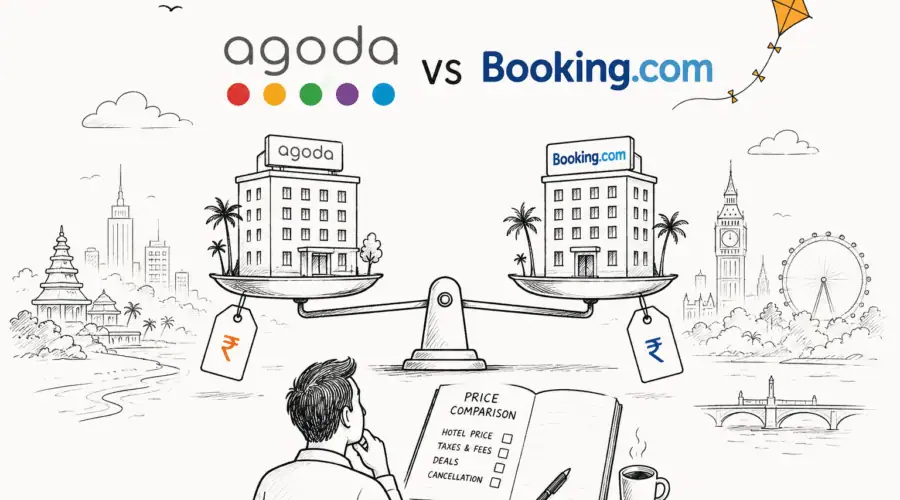
You have two browser tabs open. Same hotel. Same dates. One platform is noticeably cheaper than the other. That gap is real, and it is not random: it comes from how each platform buys its rooms, and it follows a regional pattern. Here is where each platform tends to win, why, and the three-minute check that settles it for your dates.
Agoda wins in Asia-Pacific. Booking.com wins in Europe and the Middle East. For Asia trips, Agoda is usually the cheaper of the two, especially on non-refundable rates. For European destinations, Booking.com usually has the edge. It is a pattern, not a law, so use both — always.
Why the same hotel shows different prices on both platforms
Agoda and Booking.com are both owned by Booking Holdings — the same parent company. Yet they regularly show different prices for identical rooms on identical dates. This is not a glitch. It is intentional, and understanding the reason saves you real money.
Agoda uses the Merchant Model. Agoda purchases blocks of rooms from hotels in advance at negotiated wholesale rates. Because Agoda has already committed money to the hotel, it can mark up or down as it sees fit. In Asia-Pacific markets — where Agoda has been operating longest and has the deepest wholesale relationships — this means genuine discounts that Booking.com cannot match.
Booking.com uses the Agency Model. Booking.com acts as a middleman. The hotel sets the price; Booking.com takes a commission. This means the rate you see on Booking.com is essentially the hotel’s own rate, minus whatever discount the hotel chooses to offer. In markets where hotels have strong relationships with Booking.com — primarily Europe — this model works well. In Asia, it often loses to Agoda’s pre-purchased inventory.
“Agoda and Booking.com are siblings with different pocket money. Agoda buys in bulk and passes savings on. Booking.com passes through the hotel’s own rate. Knowing which model works where is the entire game.”
— The Bookie
Where Agoda wins: Asia-Pacific destinations
Agoda started in Asia in the mid-2000s, and its wholesale relationships there are the deepest it has. Its edge is most pronounced in Thailand, Indonesia, Vietnam, Japan and South Korea. For a city-level example, see our month-by-month Tokyo hotel price guide.
| Market | Usual edge | Why |
|---|---|---|
| Thailand, Vietnam, Indonesia | Agoda | Deep wholesale room blocks and the widest choice of local independent hotels |
| Japan, South Korea | Agoda (check direct too) | Strong Agoda inventory; Japanese business chains often price best on their own sites |
| Singapore, Hong Kong | Close call | Big international chains here tend to set similar rates on both platforms |
| Resorts (Bali, Phuket) | Agoda on non-refundable | Prepaid merchant rates undercut flexible agency rates |
These are tendencies, not guarantees. Always compare the same room, same dates and same cancellation terms.
For Asia travel, start with Agoda — it usually comes out ahead across the region:
Search Agoda for Asia hotels →Where Booking.com wins: Europe and the Middle East
In Western Europe, Booking.com built its global dominance. Its relationships with European hotels are deeper and older than Agoda’s, and many small European independents list there and nowhere else. That is why it is the Bookie’s first search for Europe and the Middle East.
| Market | Usual edge | Why |
|---|---|---|
| Western European cities | Booking.com | Older, deeper hotel relationships and more flexible rates listed |
| Small European independents | Booking.com or direct | Many family-run hotels list on Booking.com only, or price lower direct |
| Dubai and the Gulf | Booking.com (check Agoda) | Hotels mostly sell agency rates; Agoda sometimes matches on prepaid |
| Like-for-like flexible rate | Usually Booking.com | Agoda’s cheapest rates are mostly non-refundable |
For European and Middle Eastern destinations, Booking.com is usually the better first search:
Search Booking.com for Europe →The flexibility factor: Booking.com wins hands down
Price aside, Booking.com has one structural advantage that Agoda cannot match: cancellation flexibility. Most Booking.com listings offer at least one free-cancellation rate, typically up to 1–7 days before check-in. You can book a room in Paris six months out, pay nothing today, and cancel for free 24 hours before arrival.
Agoda’s lower prices almost always come with a catch: the cheapest rates are non-refundable prepay. When you force a like-for-like comparison — same cancellation terms — Agoda’s price advantage often shrinks or disappears. Before you rely on the badge, read what Booking.com’s free cancellation really covers.
The Bookie’s rule on flexibility: If your itinerary is locked and your plans won’t change, Agoda’s non-refundable rates are genuine value. If there’s any uncertainty — visa pending, flight connections, flexible dates — pay for the Booking.com free cancellation. The peace of mind has a price. It is usually worth it.
Agoda often shows app-only deals that its desktop site does not. Check the Agoda app before finalising any Asia booking. Download it before you search.
The Bookie’s recommended strategy: use both, always
The single biggest mistake travelers make is being loyal to one platform. Both Agoda and Booking.com belong to the same parent company — they are competing for your booking, and that competition is what creates the price gap.
The Bookie’s 3-step booking process for any hotel:
- Search Agoda first if your destination is in Asia-Pacific. Search Booking.com first if you are travelling in Europe, the Middle East, or Africa.
- Open the rival platform in a second tab and search the identical room on the same dates. Compare the total price including taxes — not just the nightly rate.
- Check direct. For independent and boutique hotels, the hotel’s own website occasionally beats both platforms. Worth 60 seconds. If you book on Booking.com, also check whether the Genius discount applies.
On a week’s stay, the gap between the cheapest and the dearest of those three tabs can easily cover a good dinner. That is a strong return on three minutes of work.
Agoda for Asia. Booking.com for Europe. Both platforms for every booking. That is the entire strategy. The traveler who spends 3 minutes checking both platforms consistently pays less than the traveler who picks a favourite and sticks with it. There are no loyalty rewards worth the price difference.